Brand Forum 2026 – A New Beginning for Brands

Why hospitals and hospital groups should rediscover their brands now
At this year’s Brand Forum in Brand, Vorarlberg, the theme is Aufbruch Marke, or A New Beginning for Brands. Meanwhile, Europe continues to debate bureaucracy, cost pressures and skills shortages. Hospitals are grappling with healthcare reforms, the shift towards outpatient care, economic uncertainty and the struggle to attract and retain staff. At the same time, artificial intelligence is changing how people find information, make decisions and build trust.
At a time like this, it might be tempting to regard branding as a luxury.
Quite the opposite. In times of change, something long underestimated becomes more important: the direction a brand can provide. When circumstances shift, people look for something they can rely on. That applies to employees just as much as to patients, relatives, referring clinicians and policymakers.
The hospital as a brand
Many hospitals still communicate primarily through their services: specialist departments, certifications, areas of expertise or bed numbers. All of these matter. Yet people rarely choose a hospital on the strength of a certificate alone. Applicants do not choose an employer because of its organisational chart. And referring clinicians do not necessarily recommend the institution with the most awards.
Ultimately, people trust people. And they trust organisations that make clear what they stand for.
That is why brand development begins with identity. It asks why an organisation exists and what contribution it makes to people’s lives. This is the foundation of a brand that can offer genuine direction.
A new beginning does not mean reinventing yourself
When we talk about a new beginning, we often think of change: new strategies, processes or communication initiatives. Yet meaningful progress often begins with rediscovering what is already there.
Hospitals frequently have remarkable histories, committed employees and values that have developed over decades. The challenge is rarely a complete absence of values. More often, those values have become less visible in everyday life. Amid budgets, restructuring and operational demands, it is easy to lose sight of what defines an organisation at its core. Yet that is precisely where its greatest strength lies.
Values have an impact when people can experience them: in how colleagues treat one another, in the decisions an organisation makes, and when patients, employees and partners see that its promises match reality.
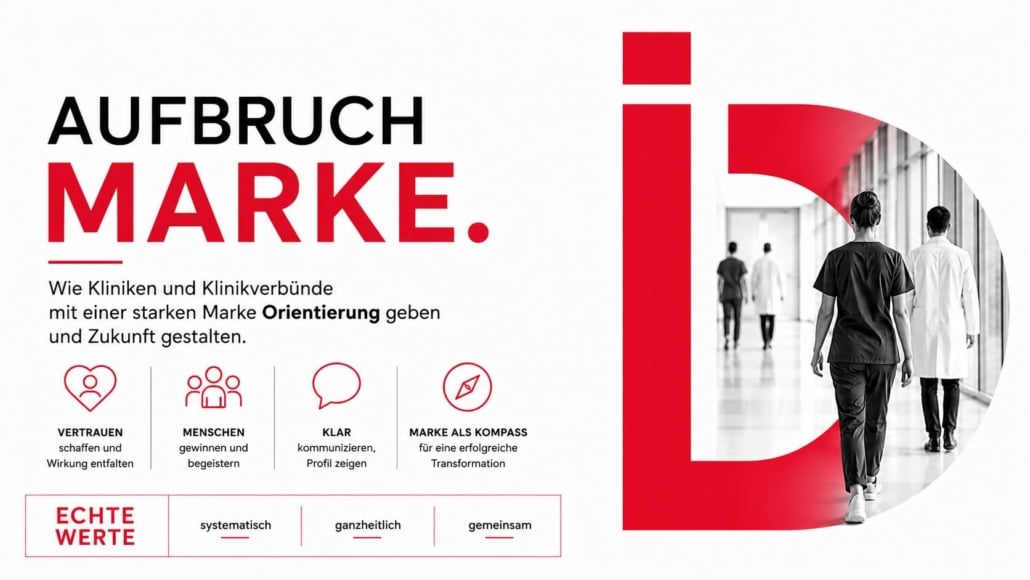
A new beginning for hospital brands in 2026
1. Trust becomes the most valuable currency
People have never had so much information at their fingertips. Review platforms influence decisions. AI systems answer health-related questions. Recommendations spread in seconds. Trust has therefore become one of the most valuable assets of all.
Trust develops when people experience consistency between words and actions, and when an organisation behaves predictably, credibly and reliably.
2. The competition for talent becomes a search for meaning
Many healthcare organisations invest in recruitment campaigns, careers websites and employer branding. These are important measures. But applicants’ expectations have changed. Younger generations in particular want to know more than what a role involves. They want to understand what an organisation stands for and what contribution they can make. People seek belonging, direction and purpose.
Organisations that can answer these questions convincingly have a real advantage in attracting talent. Authenticity carries more weight than a polished campaign alone.
3. Communication needs a common thread again
There has never been so much communication. Websites, social media, careers portals, newsletters, media relations and internal communications often operate in parallel. The result can be a great deal of activity with surprisingly little recognition. Individual messages may all be accurate, yet fail to create a coherent overall picture.
This is where a brand provides direction. It connects individual activities into a shared story and ensures that every message reinforces the same identity.
4. AI makes identity more valuable, not less
Artificial intelligence will transform communication for years to come. Text can be produced faster, content distributed more efficiently and processes automated. These developments create enormous opportunities. They also raise a new challenge: as more content can be generated technically, what is genuinely distinctive about an organisation becomes even more important. AI can write text, generate images and analyse data. It cannot create a credible organisational identity on its own.
The more interchangeable communication becomes, the more valuable the things that cannot simply be copied: an organisation’s attitude and the people who shape it.
Brand as a system of orientation
Healthcare will continue to change in the years ahead. New models of care will emerge. Technology will alter working practices. The expectations of patients and employees will evolve. That is why hospitals need more than isolated marketing activities or short-term communication campaigns.
They need a reliable point of reference.
In our experience, brands have the greatest impact when they connect strategy, communication, leadership and culture. When they provide direction internally as well as externally, they become a steady anchor in turbulent times. Perhaps now is the right moment to rethink the brand as a source of orientation in an increasingly complex world.
I look forward to the insights, experiences and perhaps even challenging perspectives that the Brand Forum in Brand will bring to the theme Aufbruch Marke. After all, the best conversations often begin with a good question rather than a ready-made answer.
Frequently asked questions about hospital brands and brand management
Why is brand management important for hospitals?
Because patients, employees and referring clinicians increasingly seek clarity and reassurance. A strong brand builds trust, makes differences visible and gives an organisation a clear direction.
How do you develop a strong hospital brand?
By clarifying identity, values, attitude and positioning. These foundations make credible communication possible and give visual design and campaigns a clear purpose.
What makes a successful employer brand in healthcare?
It communicates purpose, culture and belonging alongside responsibilities and benefits. People increasingly look for organisations whose values they share.
How can hospitals build trust?
By ensuring that promises and reality align. Trust grows when people experience commitments being honoured.
What role does AI play in brand management?
AI can accelerate communication, but it cannot replace identity, attitude or trust. That makes a strong brand even more important.
How can hospitals attract skilled professionals?
Through a clear employer brand, authentic communication and an organisational culture that people genuinely experience in their daily work.
Why do hospital groups need a shared brand strategy?
Because it provides direction, creates synergies and builds a consistent picture both internally and externally.
What does brand identity mean for hospitals?
Brand identity describes the core of an organisation: its purpose, values, attitude and contribution to patients, employees and society.